
|
|
Determining Water Quality Differences Between Swept and Unswept Street Segments
SCCWRP has been tasked by its member agencies to quantify if there is a measurable difference in water quality as a result of street sweeping, in order to support assumptions on pollutant load reductions in their NPDES MS4 permits. SCCWRP is conducting controlled, field testing using a custom-built rainfall generator. They are working with municipalities to identify locations and coordinate logistics so that we have test sites that create both conditions in the same street (either opposite sides of the same street or just different sections along the same block).
Here is a video of the team in action the first week of April 2026 (no sound on this one): And here is a video with sound that explains more about the rainfall generator itself. The password for both is 3535. Fassman-Beck said they are expecting quite high variability from location to location, so are testing lots of locations – with a bit of luck, they will collect samples from about 20 locations by the end of the calendar year. They are grouping to the extent feasible factors like surrounding land uses (e.g. residential vs commercial) and sweeper type, as well as mandating that the sweeping frequency is the same in all locations (weekly). "We are only at the beginning of deployments," Fassman-Beck continued, "so we do not have results to share as yet. That said, here's a nice demonstration from our first test of what we are anticipating – color is not a pollutant per se, but there's a pretty good indication that something beneficial is happening when we take a look at what's deposited on a filter after filtering only 1L of collected runoff. 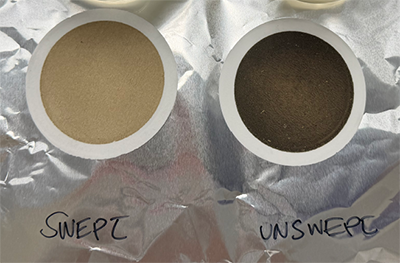
"I think the same data we are collecting could be used for other studies e.g. to compare performance of sweeper types or operation. The method is repeatable, and mobile. While it is labor-intensive to conduct testing, the actual equipment is relatively low cost (we built it all for $5K in 2023).
Here's the science behind the rainfall generator – paper attached or downloaded here:
Tiernan, E., J. Gray, L.S. Beck, E. Fassman-Beck. (2025). Novel design of a mobile, field-scale rainfall generator for urban runoff water quality studies. Journal of Irrigation and Drainage Engineering 151(4):
For more insights, contact Elizabeth Fassman-Beck via email sent to elizabethfb@sccwrp.org, or WorldSweeper's Editor. WorldSweeper offers an award-winning free e-newsletter including links and summaries of pavement and sweeping research. If you do not currently receive it, use this signup link.
|
 "In a nutshell," says Fassman-Beck, "we make it 'rain' on the swept segments and then collect all the runoff. Immediately following, we make it rain on the unswept segments and collect all the runoff in a separate vessel. We analyze the collected runoff water quality in the lab for a long list of contaminants – conventional pollutants like sediment, nutrients, and heavy metals as well as emerging contaminants like microplastics and a big list of pesticides."