
Dr. Andrew Sheerin has developed software designed to help municipalities and others know the best ways to sweep: when to sweep, how often to sweep and the value of sweeping when it gets done. His Stormwater Pollution Tracker, SWPT, may well revolutionize street sweeper scheduling given its prediction ability about when to sweep for best results for pollution removal.
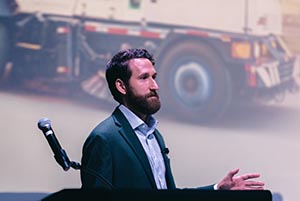 Andrew Sheerin: My involvement started in graduate school, when I worked on a project for the Rhode Island Department of Transportation to improve its non-structural best management practices. Street sweeping quickly stood out as a strong candidate. As I researched ways to optimize Rhode Island's sweeping program, I realized there were very few tools available. Coming from a computer science background, I took a modeling and data-driven approach, which led to the development of the SWPT. That application helps optimize sweeping routes and creates metrics to quantify program performance.
It has been about four years since I began that research, and now I'm focused on getting the technology into the hands of municipalities and programs that can use it. That work introduced me to this industry, and it has been a very welcoming one. It also brought me into contact with Ranger and the World Sweeping community. As someone who works in modeling and data, I see enormous value in what WorldSweeper.com has built over the years by compiling articles, studies, and resources for municipalities, manufacturers, contractors, regulators, and researchers. There is a great deal of data available to advance this industry, and I believe there are very good things ahead.
Ranger Kidwell-Ross: Andrew came to my attention for exactly those reasons. I'm looking toward retirement after nearly 40 years in this field, and we've begun a collaborative effort we're calling World Sweeper 2.0. The idea is to use AI-assisted tools – what I prefer to think of as "Augmented Intelligence" – to better serve the power sweeping industry, including contractors, public works departments, and especially stormwater professionals.
Sweeping has increasingly proven to be one of the most cost-effective ways to remove pollutants, especially phosphorus and nitrogen, before they enter waterways. In many cases, it is three to five times more cost-effective than the next best alternative. The challenge is getting that message out more broadly.
Andrew Sheerin: The vision for World Sweeper 2.0 is to make the site's information more transparent, usable, and targeted. A municipal employee, for example, should be able to come to the site and quickly find guidance on best practices for sweeping operations within a stormwater management plan. To get there, we need to assimilate and standardize the large amount of information gathered over the last 40 years, run it through quality-control protocols, and then use it to support an AI-based large language model.
In practical terms, that means users would be able to ask questions through a chatbot or similar interface and receive relevant resources, studies, and operational guidance. It will take data cleaning, standardization, and model training, but the end result could be a genuine decision-support system for the industry.
Ranger Kidwell-Ross: We also expect to involve other organizations across the sweeping field, giving them the opportunity to license data, contribute their own information, and help build a resource that serves the entire industry. The goal is that whether someone comes from a public agency, a contractor, a manufacturer, or an association, they can find meaningful ways to improve performance.
A major need is helping communities meet stormwater compliance requirements. There are well over 1,000 cities that are out of compliance with runoff programs. If we can provide better information, easier access, and stronger decision tools, we can help those cities improve. We also want to support the development of sweeping credits, similar to what some states have already begun exploring, so that enhanced sweeping programs can earn formal recognition for their environmental value.
Andrew Sheerin: That is one reason I try to use the term power sweeping rather than only street sweeping. We should not forget the rest of the impervious surfaces out there, especially parking lots, which also contribute substantially to runoff. The challenge with credits is that sweeping performance must be proven in a way regulators accept. Right now, sweeping remains underutilized across the country, but the path forward is clear: we need to prove environmental performance through science and data.
Ranger Kidwell-Ross: That is exactly why this work matters. With data and better coordination between stormwater agencies and public works departments, we can show the value of sweeping much more clearly. We can demonstrate how much pollutant is on the road, how much is likely to wash off, and how much can be removed. That creates a stronger case for budgets, equipment decisions, and improved operating practices.
 Andrew Sheerin: The SWPT software, like Roger Sutherland's SIMPTM model, is a pollutant transport model. It simulates pollutant accumulation on impervious surfaces over time, wash-off during rain events, and removal through sweeping. Once you have those three components, you can compare different sweeping scenarios.
A common example is comparing a traditional biweekly sweeping program with a more dynamic, rain-based sweeping program. Many cities sweep every two weeks regardless of whether rainfall has already removed material or whether a major rain event is imminent. In those cases, a scheduled sweep may happen after the most important pollutant load has already washed into receiving waters.
My model instead factors in rain forecasts. If a significant rain event is expected, roads should be swept as close to that event as possible in order to maximize pollutant removal before wash-off occurs. The model also helps answer where to sweep by layering GIS-based information such as land use, tree canopy, and traffic volume. That makes it possible to create a priority map and decide which routes and which types of sweepers should be assigned where.
For instance, if a municipality is focused on nutrient reduction, then canopy-covered or residential areas may deserve more attention because of phosphorus and nitrogen inputs. If the concern is heavy metals, then high-traffic commercial and industrial corridors may be the better focus. The system is designed to answer both when to sweep and where to sweep.
Ranger Kidwell-Ross: That kind of information gives public works departments something very concrete to bring to city councils and budget authorities. It also helps illustrate the importance of keeping roads clear for sweeping. If a parked car blocks a sweeper, several car lengths of roadway may be missed, and that lost opportunity can now be quantified.
There are also practical ways to improve operations, such as notifying residents before sweep day, alerting them when a sweeper is nearby, and using license-plate images to identify vehicles that obstruct the route. On top of that, we can provide better maintenance guidance so sweepers last longer and perform better.
Another important point is particle size. Only about 10 percent of the material on a street may be 250 microns or smaller, but that fraction can hold as much as 60 percent of the pollutant load. That finer material is also more likely to wash off or become airborne, which is why removing it matters so much.
Andrew Sheerin: One advantage of Swept is that it can track individual particle-size ranges and, within those, specific pollutants such as phosphorus, zinc, or copper. That allows a program to quantify annual reductions in pounds, which could tie directly into a crediting framework where one exists, or where one may exist in the future. The tools to support those frameworks are already available; the next step is integrating them into municipal programs and regulatory structures.
Ranger Kidwell-Ross: Once cities understand how much they are sweeping, how much they should be sweeping, and how to optimize the process, the cost argument changes. Sweepers are expensive machines, but when the goal is pollutant removal, they remain far less expensive than most alternatives.
Andrew Sheerin: I would also stress that I am not an advocate for extremely frequent sweeping. That is where costs and maintenance demands can become excessive. In many of the model runs I've done, a biweekly program reduces stormwater pollution by about 15 percent compared with no sweeping at all. But a more targeted rain-based program can cut pollution by nearly 50 percent while requiring only half as much sweeping, or even less.
That is the real value of a dynamic approach. You use fewer resources, reduce wear on the equipment, and capture far more pollutant because you are sweeping at the right times. In practice, it may not be feasible to sweep an entire network immediately before a storm, which is why priority routes matter. High-priority corridors can be addressed before rain events, while lower-priority routes can remain on a routine schedule.
Ranger Kidwell-Ross: We have covered a great deal of ground, and I think this gives readers and listeners a much clearer picture of where the field is going.
Andrew Sheerin: I agree. We have done a lot of work to reach this stage, but the next step is moving these models off my computer and into pilot programs with selected municipalities. At the same time, we want to continue building World Sweeper 2.0 into a transparent and interactive environment that helps people digest complex information and make better operational decisions. I see these tools primarily as decision-support systems, and I believe there is much more to come.
Ranger Kidwell-Ross: We are also anticipating collaboration with groups such as the National Municipal Stormwater Alliance. Seth Brown has been especially helpful and recognizes the value of the ideas we have been discussing. Parts of the manufacturing community have also contributed support to help evaluate these concepts and improve decision-making.
Andrew Sheerin: I would also mention the Clean Streets, Cleaner Water initiative being led by NMSA, Seth Brown, and Greg McPartlin. It is exciting because it is working toward guidance for a nationwide crediting framework. There are strong people working on the regulatory side of this issue, and I'm very interested to see where that leads.
Ranger Kidwell-Ross: We have also had encouraging contact with the EPA, which has shown interest in learning more. So with that, thank you very much, Dr. Sheerin. I look forward to eventually handing things over – while still staying involved as the person who has been working on this for many years.
Andrew Sheerin: Thank you. It has been a pleasure, and it has been great working with you on all of this. I have no doubt you will stay involved. But I also think there are some very good things ahead, and I appreciate the opportunity to discuss them.
Andrew can be contacted via email sent to: asheerin@fathomsolutions.dev.
|