
|
The Latest Products and Info
|
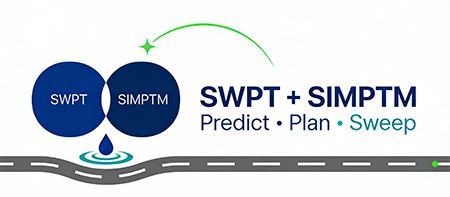
Pioneering Collaboration: Toward a Unified Street Sweeping Optimization Platform
An intriguing collaboration is taking shape between two leaders in environmental modeling whose software innovations could redefine how cities manage street sweeping and stormwater pollution. Facilitated by WorldSweeper's Editor, Ranger Kidwell-Ross, the discussion brought together Andrew Sheerin, PhD, founder of the SWPT program, and Roger Sutherland, well-known sweeper tester and the developer of the SIMPTM model, to explore how their respective tools might be combined into a more powerful, integrated solution.Andrew's SWPT software harnesses GIS data to dynamically optimize street sweeping operations. By factoring in land use, tree coverage, traffic volume, and weather forecasts, SWPT prioritizes roads in real-time, directing sweepers when and where they are most needed. This data-driven scheduling aims to replace traditional static route lists with adaptive decision-making grounded in pollution accumulation patterns.Roger, meanwhile, brings decades of experience in stormwater modeling. His SIMPTM (Simplified Particulate Transport Model) traces its roots to the 1980s, when he first identified how rainfall redistributes contaminated materials—sometimes washing pollutants onto streets during storms rather than off of them. His model simulates particle build-up and wash-off processes, helping agencies understand how sweeping frequency and intensity affect stormwater quality. Roger's work highlights why sweeping during wet weather is often ineffective—but missing optimal pre-rain periods can greatly increase pollution runoff. Roger was the original author who coded and introduced the model in 1986. Seth Jelen joined the team in 1990 and was instrumental in significant improvements to the model, documented in the first User's Model in 1999 (Version 3.2). Major improvements were made by Seth with the release of Version 5.0 in 2004. The group's discussion underscored a shared vision: merging SWPT's predictive scheduling and GIS interface with SIMPTM's pollutant mobilization science could produce a comprehensive Street Sweeping Optimization Suite. This unified platform would not only guide sweeping operations but also quantify the environmental value of each sweep—connecting cleaner streets directly to measurable water quality benefits. 
Beyond modeling, the conversation explored practical tools to make the technology more actionable for municipalities. Integration with automated ticketing systems, resident notification services, and potential "sweeping credit" systems could streamline operations and unlock new funding mechanisms. Both Andrew and Roger expressed interest in developing a subscription-based, software-as-a-service model that could reward cities for verified pollutant removal through stormwater quality credits. Ranger observed that this emerging partnership signals an exciting shift for the street sweeping profession – marrying decades of field experience with cutting-edge data analytics and AI. Andrew and Roger agreed to begin formal presentations of their respective software, laying the foundation for co-development discussions expected to follow soon. If successful, their collaboration could produce a next-generation tool that turns ordinary street sweeping into a fully optimized stormwater management solution. You may reach Ranger via email sent to ranger@worldsweeper.com; for Roger, send to sutherland.roger1@gmail.com; for Seth Jelen send to Seth.Jelen@wsp.com; for Andrew send to asheerin@fathomsolutions.dev. WorldSweeper offers an award-winning free e-newsletter packed with a variety of information about the power sweeping industry. This includes links to studies and reports, among many other topics. If you do not currently receive the newsletter, use this signup link. |
 © 2005 - 2026 World Sweeper All rights reserved. |
Industry Updates Contents
|